The State of the Pharmacy Technician Workforce 2025
PTCB /

To the Pharmacy Community,
In 2022, our workforce survey captured a profession at a crossroads, navigating the immense pressures of a global pandemic while simultaneously expanding roles. We spoke of a “workforce in transition.”
Today, the data tells a new story: one of sophisticated stabilization. We are witnessing the emergence of an “Expert Core,” a growing segment of veteran technicians who view this profession not just as a job, but as a lifelong career. While the challenges of competitive compensation and workplace stress remain, the 2025 findings highlight a workforce that is more dedicated and more integrated into the patient care team than ever before.
While there may still be a recruitment need, it is clear we are standing before a massive retention opportunity.
At PTCB, we remain committed to empowering these essential healthcare professionals by providing the credentials and advocacy they need to excel in their evolving roles.
William Schimmel, CAE, ICE-CCP
Executive Director & CEO
The 2025 Pharmacy Technician Workforce Survey reveals a maturing industry characterized by clinical stability and deepening professional roots. While the so-called “Great Resignation” era focused on getting people in the door, 2025 is about keeping them there.
To ensure a statistically representative snapshot of the profession, PTCB fielded an online survey in May 2025 to over 350,000 pharmacy technicians. The survey garnered 17,112 responses from both certified and non-certified technicians across all 50 states, the District of Columbia, Guam and Puerto Rico. This report analyzes these results against 2022 and 2019 benchmarks to identify long-term workforce shifts.
The most significant takeaway from 2025 is the growth of the “Expert Core.” 42.6% of the workforce has 10+ years of tenure as pharmacy technicians, and the percentage of technicians with more than 10 years or more of certification has risen to 41%, an 8% increase since 2019.
This cohort represents the most experienced workforce in history. These decade-long veterans are not just filling prescriptions; they are managing complex inventory, facilitating immunizations, and serving as the final check for patient safety in high-volume environments.
Protecting this “Expert Core” through competitive incentives is no longer just a human resources goal; it is a patient safety mandate. When experienced technicians leave the field due to burnout or stagnant wages, the industry loses decades of skill and intuition that cannot be easily replaced by entry-level recruitment.
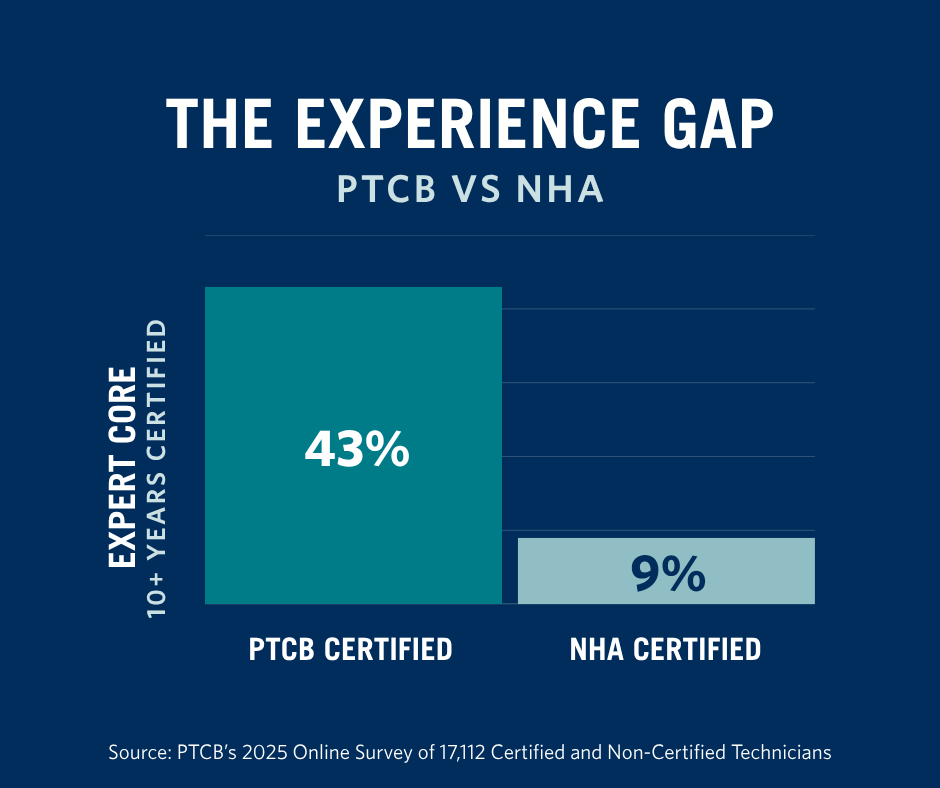
While overall certification length has increased across the profession, PTCB CPhTs have a far higher length of certified experience, with 43% of active PTCB technicians holding 10+ years of certification versus only 9% of National Healthcareer Association (NHA) technicians.
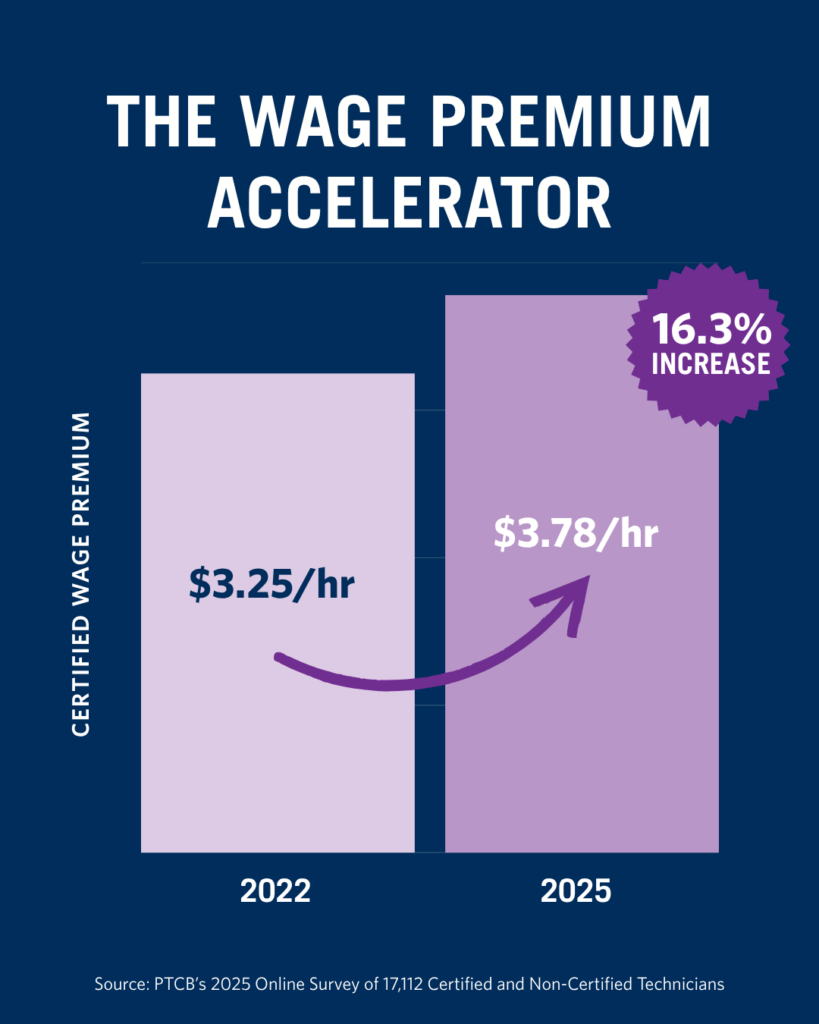
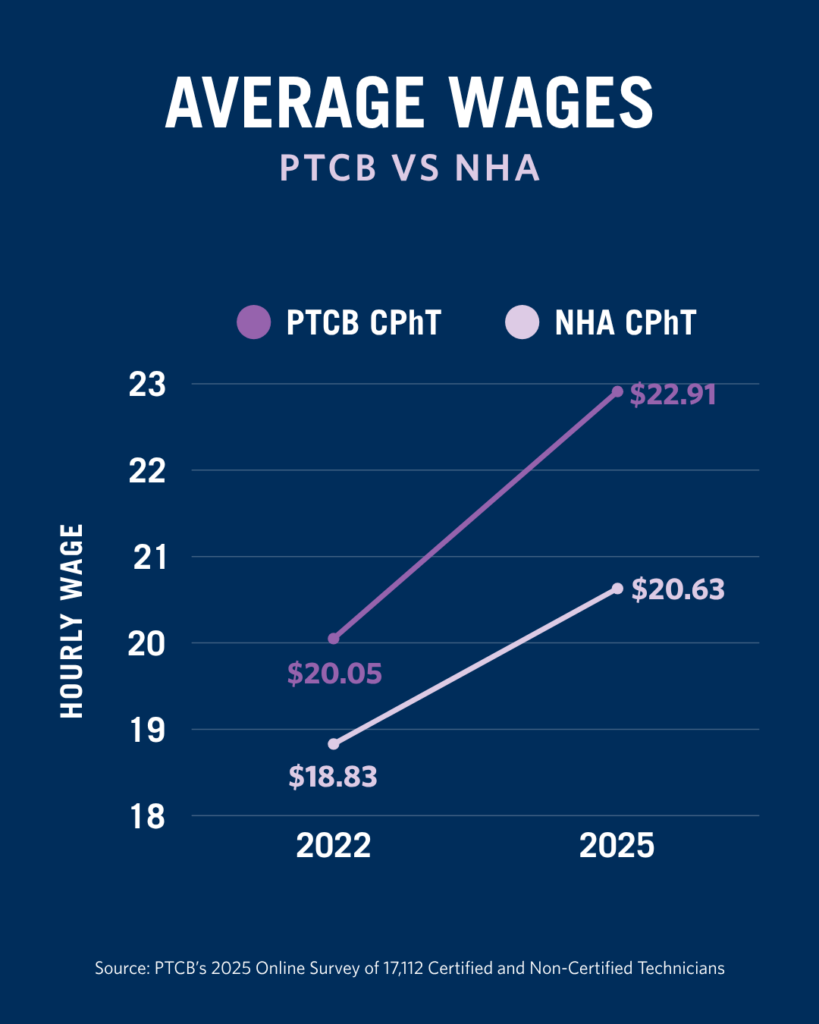
In 2025, national certification remains the single most reliable tool for increasing a pharmacy technician’s earning power. The data shows that the financial gap between certified and non-certified technicians is not just persisting—it is widening.
On average, Certified Pharmacy Technicians (CPhTs) earn approximately 20% more than their uncertified counterparts.
For employers, this data proves that certification is the primary mechanism for professionalizing the staff. For technicians, the message is clear: the path to economic stability in pharmacy runs directly through national certification through PTCB.
The 2025 data confirms that technicians want to stay in the profession. More than 63% of respondents view their role as a long-term career, up from 59% in 2022. This commitment reflects a significant post-pandemic surge in professional dedication, with PTCB CPhTs being more than 13% as likely to see it as a career than NHA CPhTs. However, a dangerous disconnect exists: while dedication is at a 6-year high, “lack of pay and incentives” remains the top driver for those considering leaving.
This commitment reflects a significant post-pandemic surge in professional dedication, with PTCB CPhTs being more than 13% as likely to see it as a career than NHA CPhTs.
We no longer have a recruitment crisis; we have a retention opportunity. While we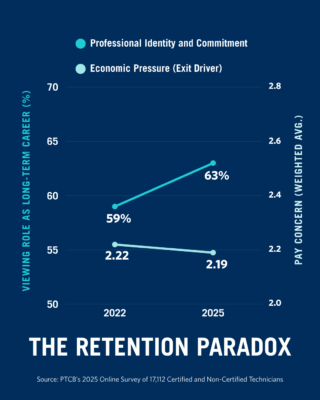 recognize that a robust pipeline of entry-level technicians is important to pharmacy, to bridge this gap, the industry must focus on career paths. Technicians are signaling that they want a path upward, not just a path in. This includes:
We no longer have a recruitment crisis; we have a retention opportunity.
This shows a “Retention Paradox”: Technicians are more dedicated to the profession than ever, but the economic pressure is the primary force pushing them out.
This paradox is significantly mitigated by the PTCB credential, as 40% of active PTCB CPhTs have been with their current employer 6+ years, compared to only 18% of NHA CPhTs, underscoring its stabilizing impact on retention.
This paradox is significantly mitigated by the PTCB credential, as 40% of active PTCB CPhTs have been with their current employer 6+ years, compared to only 18% of NHA CPhTs, underscoring its stabilizing impact on retention.
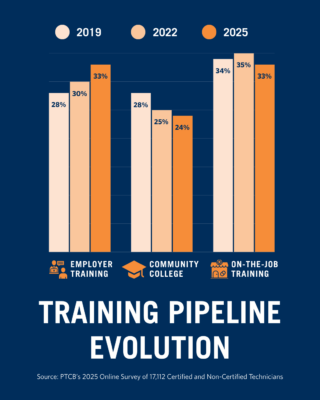
The industry’s focus on retention and professionalization is fundamentally altering the way the next generation of pharmacy technicians is educated and deployed. The 2025 data points to a significant pivot away from traditional academic routes, with employers stepping in to take greater ownership of the talent pipeline. This shift is occurring while the workforce continues to play a critical role in underserved areas.
There has been a 6.3% increase in employer-based training programs.
The results of the 2025 survey confirm that the pharmacy technician is no longer a “support” role, but a specialized profession. To sustain this “Expert Core” and continue the trend of stabilization, PTCB offers the following recommendations for employers:
By focusing on these areas, the pharmacy community can ensure that the stabilization seen in 2025 becomes the foundation for a thriving, professionalized workforce for years to come.
DOWNLOAD THE PDF VERSION
Updated August 2026